Prusa
  • SHOP
    • Latest products
    BY CATEGORY
    • 3D printersnew
    • Upgradesnew
    • Materials
    • Accessories
    • Spare parts
    • Courses
    • Merch
    • Sales inquiry & Price quote
    QUICK LINKS
    • Shipping information
    • Refunds & returns
    • Payment options
    • Warranty
    • VAT & Customs fees
    • FAQ

    0 item in your cartitems in your cart

    Your cart is empty

    Go to cartShop 3D printers

    My profile

    Log in to see orders, saved items

    My profile

    Signed in as

    • Orders
    • Logout
  • 3D PRINTING
    • Explore 3D printing
    FOR BEGINNERS
    • 3D printing 101
    • Types of printers (FDM/SLA)
    • How to choose a 3D Printer
    • Printables (3D models)
    BY APPLICATION
    • Rapid prototyping
    • Manufacturing
    • Engineering
    • Research
    • Arts & design
    GO DEEPER
    • Materials guide
    • Courses
    • Webinars
    • Case studies
    • Custom 3D printing
  • 3D PRINTERS
    • All 3D printers
    FOR
    • Home or garageHobbyists, tinkerers and home printing
    • Shop or studioIn-house production for small teams
    • EnterpriseFleets, security and scale
    • How to choose a 3D Printer
    SHOP & BROWSE
    • CORE One+new
    • CORE One+ INDXnew
    • CORE One L+new
    • CORE One L+ INDXnew
    • XL+new
    • MK4S
    • Prusa Pro HT90
    • Prusa Pro AFS
    • Prusa Pro SLX
    MORE FROM PRINTERS
    • Upgradesnew
    • Spare parts
    • Critical infrastructure
    • Case studies
    • Signature Oak
    • Kits
  • MATERIALS
    • All materials
    BY USE
    • Every-day & design
    • Functional engineering
    • Composites
    • Pro speciality
    • SLA resins
    PRUSAMENT
    • PLA
    • PETG
    • ASA
    • PC
    • PA11
    • Flex
    • TPU
    MORE FROM MATERIALS
    • Materials guide
    • We make material in house
    • Sustainability
    • Order on the store
  • SOFTWARE
    • All software
    PREPARE THE PRINT
    • PrusaSlicer 3.0New
    PRINT & MONITOR
    • Prusa Connect
    • EasyPrint
    • iOS & Android app
    • Prusa Farm
    GET STARTED
    • Download & install
    • Knowledge base
    MORE FROM SOFTWARE
    • Printables (3D models)
  • SUPPORT
    • Explore support
    FIND ANSWERS
    • Knowledge base
    • Troubleshooting
    • Courses
    • Webinars
    GET HELP
    • Contact us
    • Livechat
    • Shipping information
    • Warranty
    • Refunds & returns
    • Spare parts
    • Factory repair
    COMMUNITY
    • Forum
    • Reddit
    • Printables
  • TRUST CENTER
    • Trust Center overview
    BY TOPIC
    • GDPR
    • Certificates
    • Security
    • Compliance
    COMMITMENTS
    • Sustainability report
    TALK TO US
    • Contact the security team
  • COMPANY
    • About Prusa
    GET TO KNOW US
    • Our story
    • How we make printers
    • Open source
    • Brand & media kit
    NEWS
    • Blog
    • Newsroom
    • Events
    TRUST & PARTNERS
    • Sustainability
    • Resellers & distributors
    • Affiliate program
    • Contact
    • English
    • Čeština
    • Deutsch
    • Español
    • Français
    • Italiano
    • Polski
    • 日本語
  • Signed in as

    • Orders
    • Address
    • In-stock Alerts
    • My Courses
    • Subscription
    • Edit Account
    • Logout

Log in to see orders, saved items

Signed in as
  • Orders
  • Address
  • In-stock Alerts
  • My Courses
  • Subscription
  • Edit Account
  • English
  • Čeština
  • Deutsch
  • Español
  • Français
  • Italiano
  • Polski
  • 日本語
Shop

0 item in your cartitems in your cart

Your cart is empty

Go to cartShop 3D printers

My profile

Log in to see orders, saved items

My profile

Signed in as

  • Orders
  • Logout
SHOP
  • Latest products
BY CATEGORY
  • 3D printersnew
  • Upgradesnew
  • Materials
  • Accessories
  • Spare parts
  • Courses
  • Merch
  • Sales inquiry & Price quote
QUICK LINKS
  • Shipping information
  • Refunds & returns
  • Payment options
  • Warranty
  • VAT & Customs fees
  • FAQ

Featured products

    Popular categories

      Trending searches

        Articles

          Blog

            Products

              Categories

                Suggested searches

                  Searching…
                  No results
                  Something went wrong.
                  ↑↓ Select↵ OpenEsc Close search
                  1. Support
                  2. Original Prusa MMU2S
                  3. Printer features
                  4. Water-soluble materials (PVA/BVOH)
                   

                  Contents

                  • Which material to use
                  • Slicer configuration
                  • MMU2S, MMU3 for MK3S/+ configuration
                  • Dissolving and removing supports
                  • Handling and storing soluble filaments

                  Blog

                  • Blender for 3D Printing: The 5-Minute Guide to STL Editing
                  • Prusament Pellets: Raw material batches for large-format 3D printing or small-scale polymer research & development
                  • Print colorful and glowing Halloween decorations with our spooky offer

                  Newsletter

                  Signup and get our monthly squeeze on updates, blog, printables and much more.

                  By clicking, you agree to receive our newsletter.

                  This site is protected by reCAPTCHA Enterprise and the Google Privacy Policy and Terms of Service apply.

                  Heavy Duty Keyboard Holder (No Supports)
                  E-shop
                  • 3D Printers
                  • Printer Upgrades
                  • Filaments
                  • Accessories
                  • Prusa Merchandise
                  Prusa

                  © Prusa Research a.s.

                  Printables
                  • 3D Models
                  • Store
                  • Clubs
                  • 3D Design Contests
                  • Brands
                  Community
                  • World Map
                  • Forum
                  • User Groups
                  • Events
                  Help
                  • Prusa Help
                  • Prusa Academy
                  • 3D Printing Calculators
                  Software
                  • PrusaSlicer
                  • Prusa.app
                  • Prusa Connect
                  • Drivers and Software
                  Company
                  • About Us
                  • Blog
                  • Official Prusa Resellers
                  • Contact Us
                  • Certified for ISO 9001, ISO 14001, ISO 45001
                  • General Terms and Conditions
                  • General Terms and Conditions of Use of the PRUSA Websites
                  • Privacy Policy
                  • Information about cookies
                  • Customer Complaints Policy
                  • Status Page
                  • Do Not Sell or Share My Personal Information
                  • Supplemental Statements
                  Prusa
                  • General Terms and Conditions
                  • General Terms and Conditions of Use of the PRUSA Websites
                  • Privacy Policy
                  • Information about cookies
                  • Customer Complaints Policy
                  • Status Page
                  • Do Not Sell or Share My Personal Information
                  • Supplemental Statements

                  © Prusa Research a.s.

                  JOSEF PRUSA®, PRUSA RESEARCH®, PRUSA POLYMERS®, PRUSA ORANGE®, PRUSA 3D ® AND PRUSAMENT® are registered trademarks of Prusa Development a.s. used by Prusa Research a.s. under licence from Prusa Development a.s.

                  Water-soluble materials

                  (PVA/BVOH)

                  Relevant for

                  MMU2S
                  XL
                  MMU3
                  XL+
                  14 comments
                  Article is also available in following languages
                  English
                  Čeština
                  Polski
                  Deutsch
                  Français
                  Español
                  Italiano
                  日本語

                  Supports can be hard to remove and leave imperfect surfaces above them. Depending on the shape of the object, there is also the risk of ruining the print in the process. Some geometry is not even possible to print as a single piece using FFF printing.
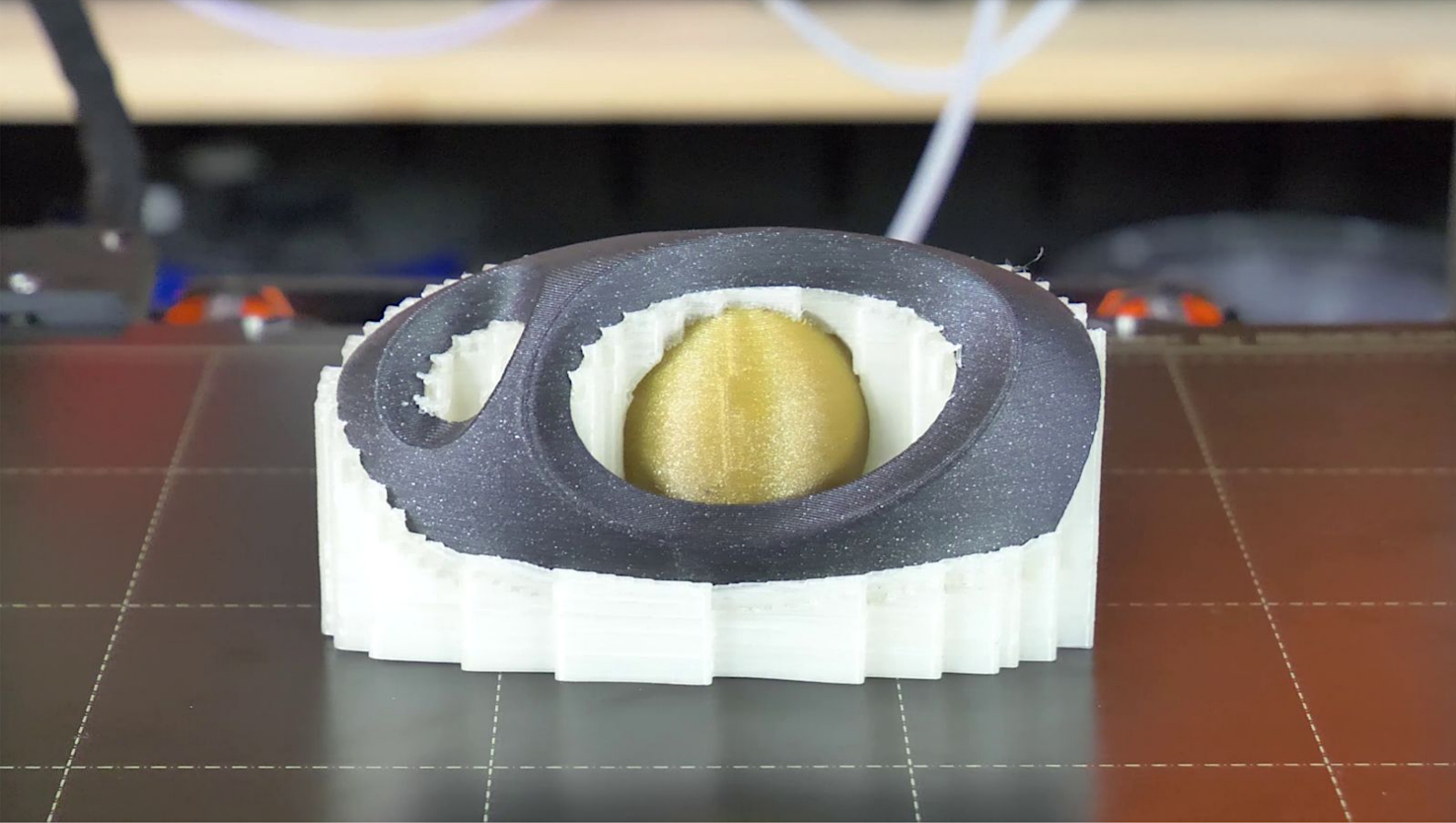
                  With the Original Prusa MMU3, MMU2S, and XL multi-tool, it is possible to use water-soluble materials, like PVA+ and BVOH, to print the supports or just the 'interface' between the print and the support structure. However, printing solubles can be demanding and requires some considerations along the way. It is a process more suitable for advanced users. 

                  Which material to use

                  The first consideration is that the main material and the soluble support material must have similar melting/printing temperatures. PVA+ and BVOH are similar in many ways, but BVOH is absolutely the better (but more expensive) option. It is stiffer and will behave much better than PVA+ when printed. This is why it is better to be printed with PETG.

                  For PETG you can practically only use BVOH. PLA can be printed with both PVA+ and BVOH.

                  If you wish to print ABS with soluble supports, your best alternative is HIPS, which can be dissolved using 'Limonene'. Make sure you read up on the different types of 'Limonene' and the health and safety considerations when using it. One alternative to PVA+ and BVOH could be PVB, which dissolves in IPA.

                  Slicer configuration

                  There is a specific configuration for the soluble support materials in PrusaSlicer. Once you have selected the Original Prusa MMU3, MMU2S, or XL multi-tool printer profile, you will find some new options in the 'Print Settings' drop-down menu. For 0.15 mm and 0.2 mm layer height, you now have the additional SOLUBLE FULL and SOLUBLE INTERFACE.
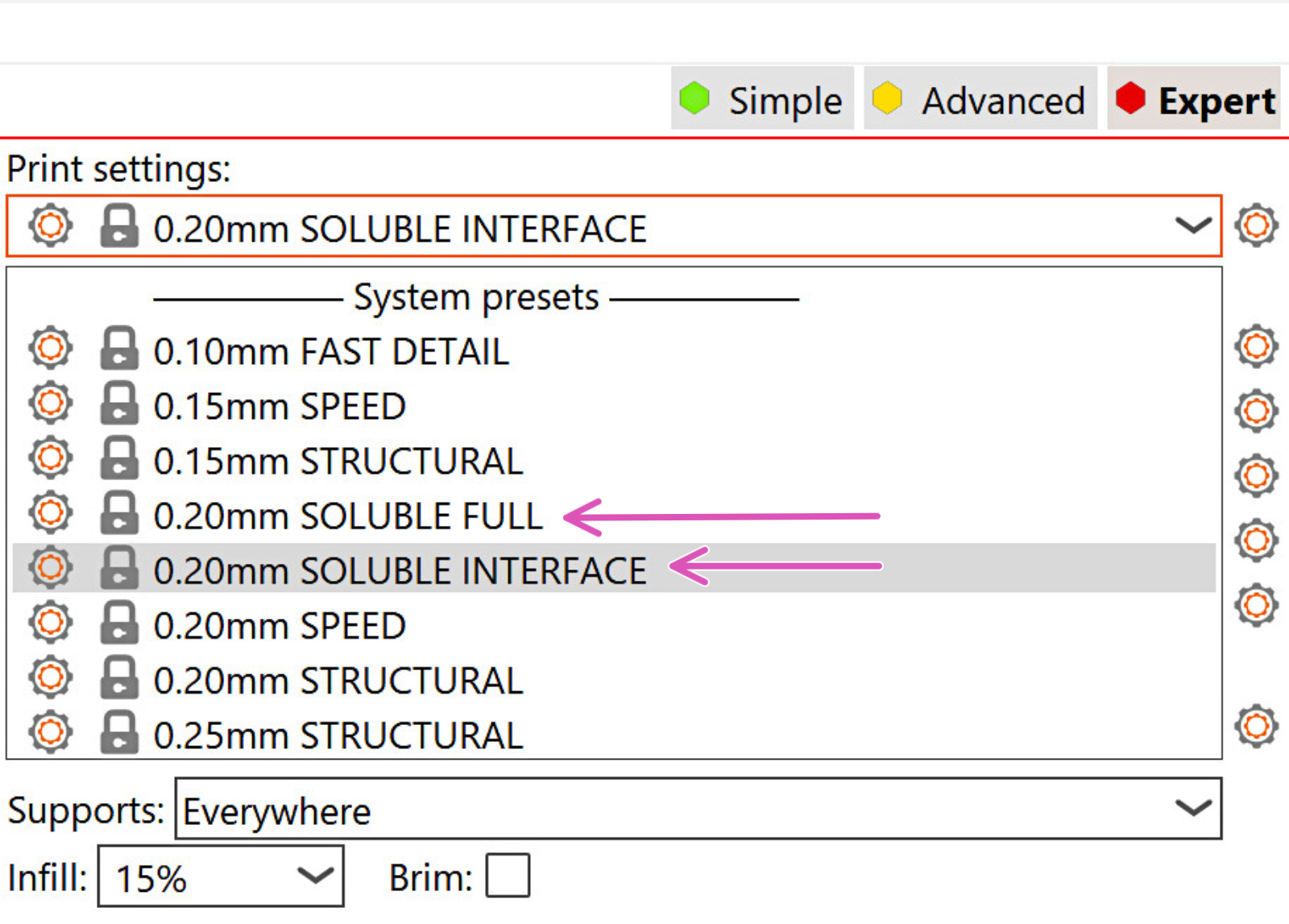
                  SOLUBLE FULL

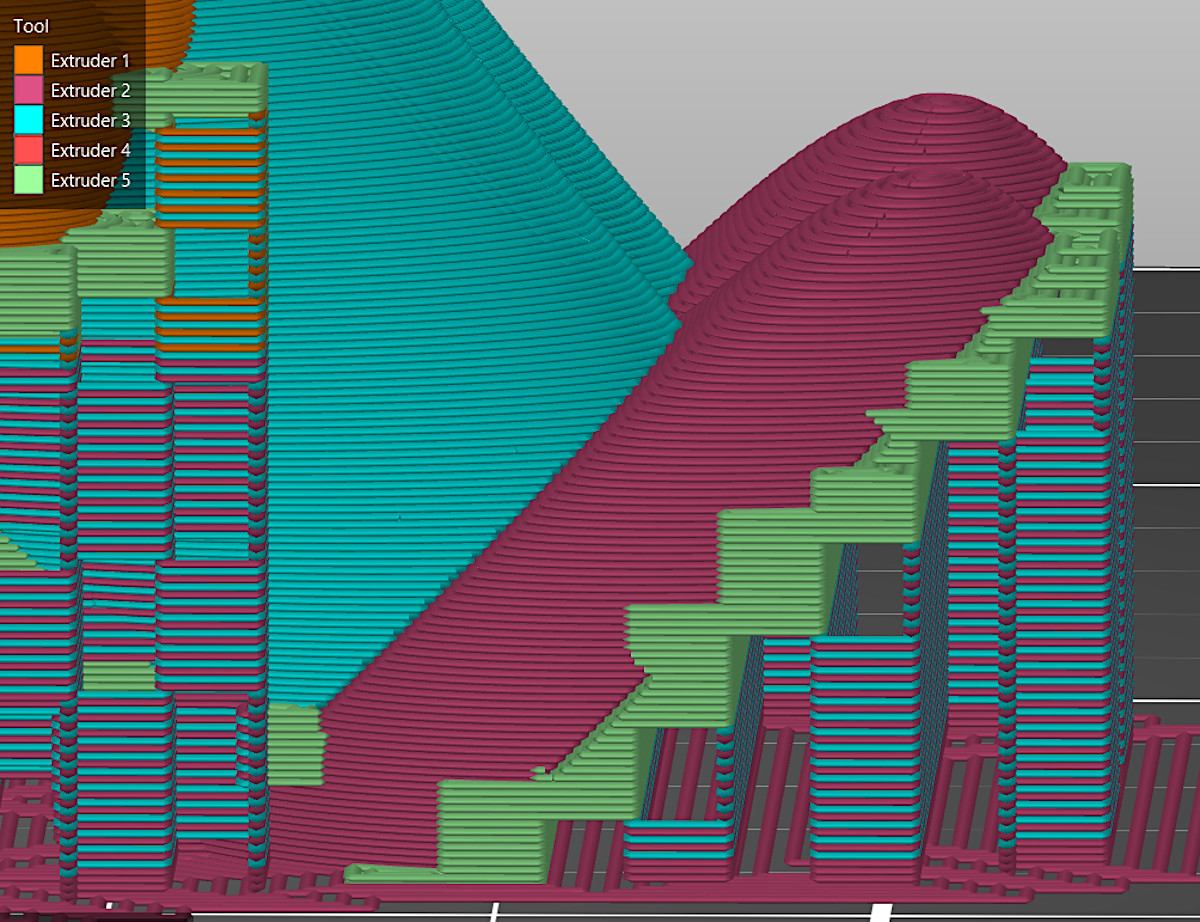
                  This option will use the soluble material for the entire support structure (left picture). This is recommended where you have complex geometry that requires a lot of internal supports only. PVA+ and BVOH adhere poorly to the Smooth PEI or Textured steel sheet but will adhere well when printed directly onto PLA and PETG. If you are printing something with supports on the build plate, we recommend the SOLUBLE INTERFACE preset.

                  SOLUBLE INTERFACE

                  This preset applies the soluble material only in the more densely printed layers between the actual support structure and the model (right picture). This allows you to print the support structure with whatever color is loaded and only uses the soluble material where it is needed. This will save soluble material, which is more expensive than PLA and PETG. If you have a print that requires a lot of support directly on the steel sheet, this is the option preset for you. 
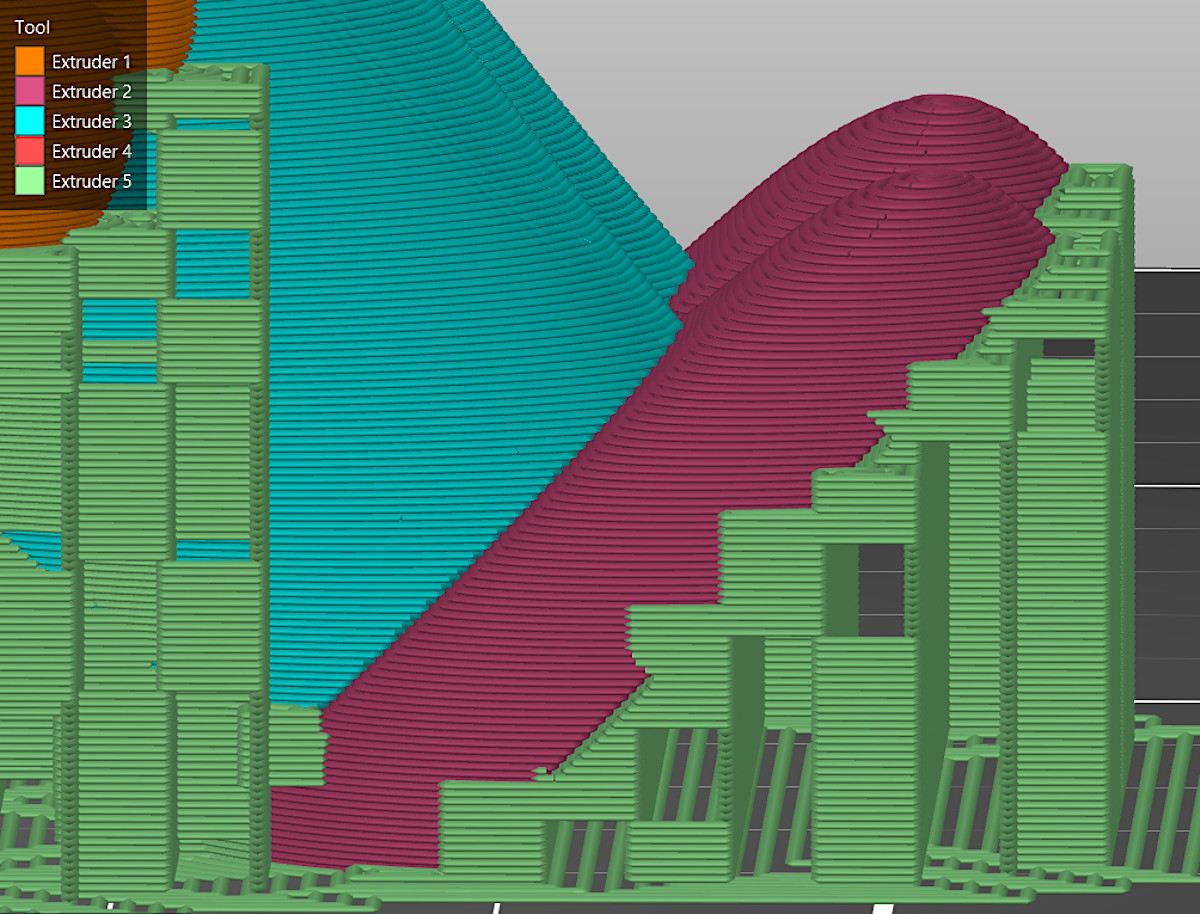
                  SOLUBLE FULL - Green filament is BVOHSOLUBLE INTERFACE - Green filament is BVOH

                  Default tool

                  PrusaSlicer or the printer will not detect where you loaded the soluble filament.

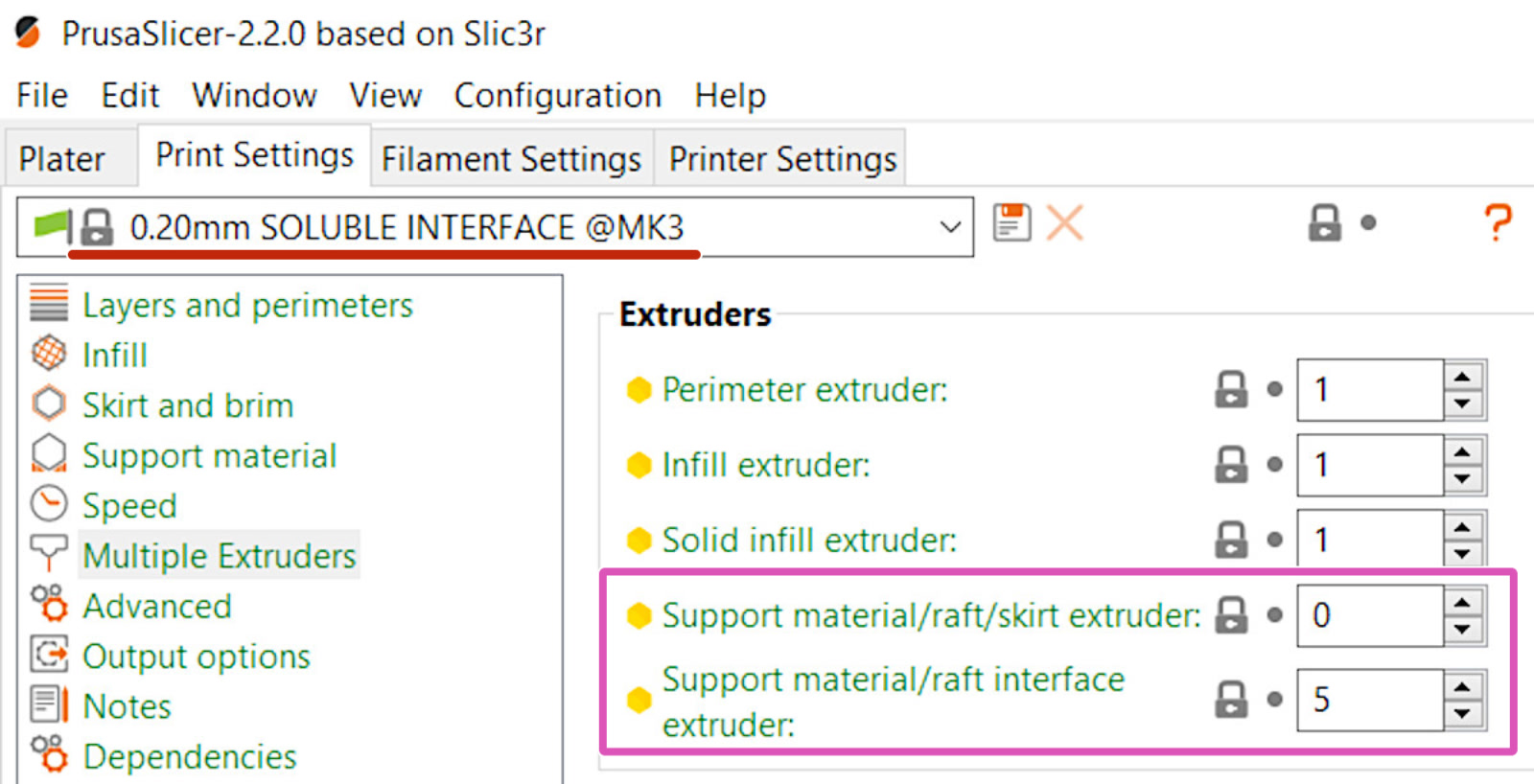
                  On MMU2S/MMU3, PrusaSlicer will default to assign the support material or interface material to Filament number 5. On XL, PrusaSlicer will assign by default the support material or interface material to Tool 2. You can change this to any other filament/tool by entering another value between 1-5, corresponding to the filament/tool to use. 

                  Setting the value at 0 uses the tool that is available, which is the last one used in that layer. 
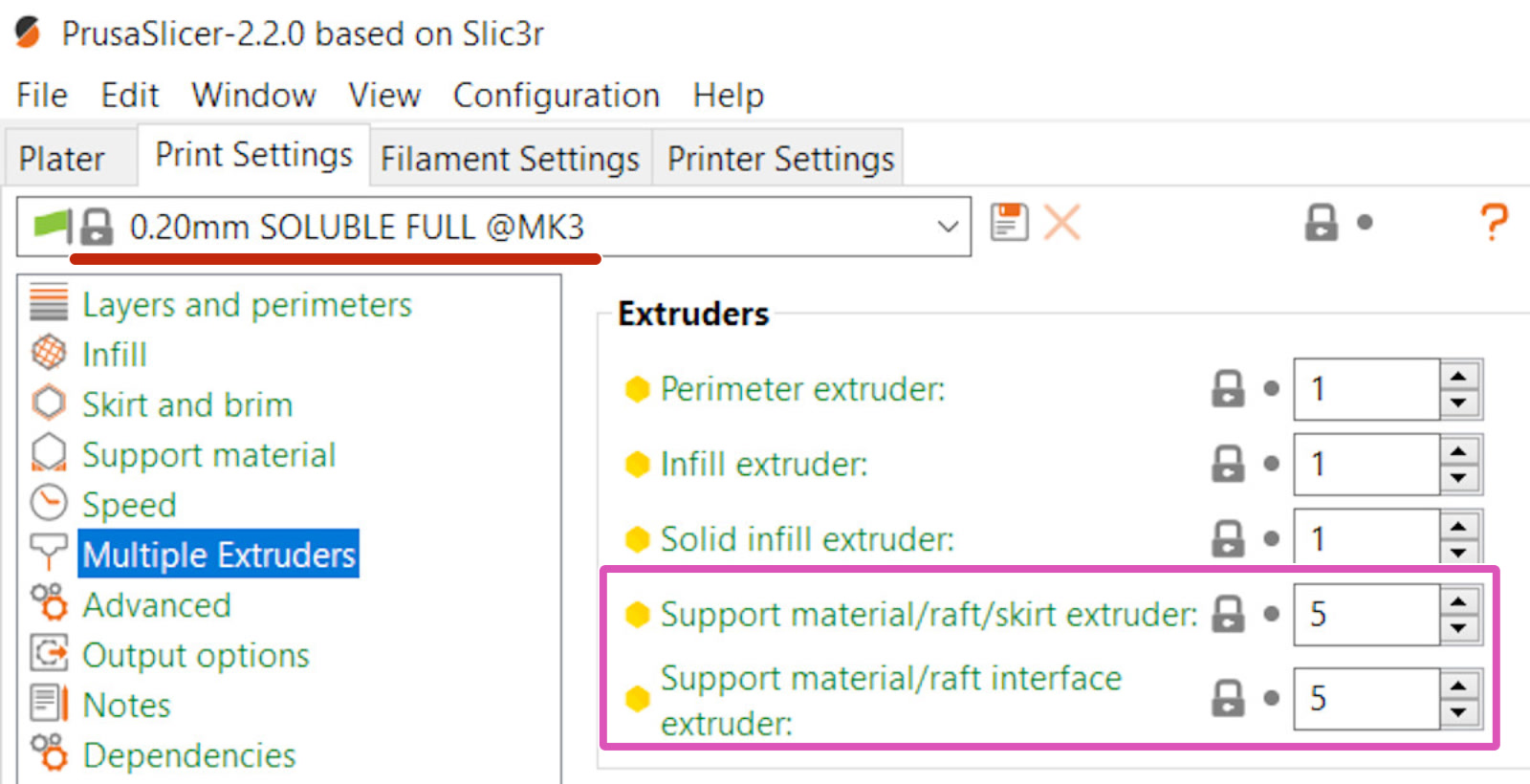
                  'Support material/raft/skirt extruder: 0' will use whatever tool is currently loaded into the extruder.

                  Purging volumes (MMU3, MMU2S)

                  By default, 140 mm³ is used for a filament change (sum of unloading and loading). When using water-soluble supports we suggest using at least 200-240 mm³. If you find any residue in your print, increase the amount. A minimum of 240 mm³ for extruder change from PVA+/BVOH may be required. 

                  To access the settings for purging volumes, press the Purging volumes... button. To be able to modify the values, select 'Use custom project-specific settings'. 

                  MMU2S, MMU3 for MK3S/+ configuration

                  It is essential that you have performed a very precise IR sensor calibration. With the properties of PVA+ and BVOH, their diameter can easily deform with excessive pressure from the idler.

                  Again, due to their soft properties, the filament tips will inevitably string, so it’s important to keep an eye on them and be ready to intervene and cut them while the main filament is being printed.

                  The difference in Max Volumetric speed: PLA has a max volumetric speed of 15 mm³/s, while PVA+, and BVOH have 4 mm³/s. This increases the total print time.

                  Dissolving and removing supports

                  When the print is complete and before removing the supports, immerse it in warm water (maximum 45 °C) and leave it there for a few hours to overnight. After this, the supports should come off pretty easily but may require some use of tools, depending on your print's geometry. It may help to remove as much of the supports as possible while still dry. 

                  Once the printed object is free from the supports, immerse it in hot water again for 10-20 minutes and then brush it to remove the residual debris of PVA+/BVOH. Using a small tough toothbrush can be an ideal tool for this task. 

                  Unless you are dissolving several kilos of PVA/BVOH per day, you can pour the resulting BVOH/PVA-solution down the sewer.

                  Handling and storing soluble filaments

                  As you might have expected, both BVOH and PVA are very hygroscopic (easily absorb water) and should be kept as dry as possible. PVA+ or BVOH should not be exposed to humidity. It must be placed right back in its zip-lock bag right after its usage, and always with one or more bags of silica. Otherwise, it will deteriorate in a matter of a few months and go soft at a much lower temperature, starting trouble already at the loading process.

                  When deteriorated like this it will quickly cause loading/unloading issues and your hotend to clog. The best approach is to print and store these materials in a Drybox.

                  Was this article helpful?
                  This action is available only to registered users. Please log-in.

                  Topics

                  • About your printer
                    • Printer features
                      • HW setup (MK2.5/S & MK3/S/+)
                      • Flexible steel sheets (guidepost)
                      • Print statistics
                      • Power-modes
                      • Prusa firmware-specific G-code commands
                      • IR Filament Sensor (MK2.5S, MK3S/+, MK3.5/S)
                      • SpoolJoin (MMU2S)
                      • Tune Menu
                      • Water-soluble materials (PVA/BVOH)
                      • Experimental settings (MK4/S, MK3.9/S, MK3.5/S, XL/+, MINI/+)
                      • Loadcell (MK4/S, MK3.9/S, XL/+)
                      • Status LED explained (MK4/S, XL/+)
                      • Nextruder filament sensor (CORE One, CORE One L, MK4/S, MK3.9/S, XL/+)
                      • Sample G-codes
                      • Buddy firmware-specific G-code commands
                      • Nextruder silicone sock (CORE One/+, CORE One L/+, XL/+, MK4/S, MK3.9/S)
                      • Model preview
                      • Cancel Object (MK4/S, MK3.9/S, XL/+, CORE One+/GEN 2, MINI/+)
                      • Tools Mapping (XL)
                      • Support settings for the XL/+
                      • Touch screen (CORE One L, CORE One, MK4/S, MK3.9/S, MK3.5/S, XL/+)
                      • Tools Mapping and Filament Mapping (XL/+, INDX, MMU3)
                      • MMU3 Prusa Nozzle vs. CHT nozzle
                      • List of parts for MMU upgrades
                      • MMU3 for CORE One L
                    • Printer description
                    • General Information

                  7 comments

                  Log in  to post a comment
                  Breeze
                  •
                  I'm having trouble using Ultrafuse BVOH on top of TPU. Particularly in the wipe tower, adhesion is very poor and the BVOH is likely to stick to the nozzle and it forms blobs which then disrupt the rest of the print. Different brands of TPU give different results: it works reasonably well (but not great) with Overture TPU, but terrible with a generic brand of transparent TPU.

                  I wish somebody would make a flexible soluble filament that interfaces well with TPU/TPE.
                  Reply
                  Finalfill
                  •
                  I had very similar issues, I just posted my solution here:

                  https://forum.prusa3d.com/forum/original-prusa-xl-tool-changer-assembly-and-first-prints-troubleshooting/trouble-printing-with-soluble-supports-pva-or-verbatim-bvoh/paged/2/#post-782071

                  TLDR: High extrusion factor (1.18 for me) and low temps (178C).

                  Hope it helps!
                  Reply
                  dleone617
                  •
                  "For 0.15 mm and 0.2 mm layer height, you now have the additional SOLUBLE FULL and SOLUBLE INTERFACE."
                  Need .15 and of course its not there, even in your screen shot above its not there. Typical.
                  Reply
                  Ian Thompson
                  •
                  Any update on when these settings are coming for MK4 with MMU3?
                   
                  Reply
                  TeunvandeBerg
                  •
                  +1, For me, support for Water-soluble materials was the main reason for which I bought the MMU3.
                  Reply
                  wizzlebippi
                  •
                  When are these profiles comming to the MK4 with MMU3?
                  Reply
                  Jan Kratochvíl
                  •

                  Hello. We cannot tell you specific date, but we are working on it ;-)

                  Reply
                  Tim A
                  •
                  I am working on a project that requires a moveable part inside the main structure. All parts are PETG. There are passages through which water can pass around the internal moveable part. However, it will not be possible to insert tools into the model to manually remove support material.
                  Will BVOH eventually dissolve completely? The project will not function properly if any support material is left behind.
                  Reply
                  David
                  •

                  Hi Tim! Unfortunately, I don't think BVOH would dissolve fully when enclosed in the object with restricted access. Is there a way to split the object in half and then use screws to assemble it together, for example?

                  Reply
                  Tim A
                  •
                  Hello David,
                  Thank you for your reply. The moving part can be "seen" from the build plate, so I will try the build based on that. It would be better to add stability throughout the build, as it takes over 24 hours to print. I will continue to work on the design to optimize for no support internally where the support material cannot be accessed for removal.
                  I do not yet have the MMU2S upgrade for my MK3S+, so I cannot experiment with BVOH yet. I am trying to determine the best course of action for the project. It seems a dual extruder setup would be better than the MMU2S in this particular case.
                  Reply