0 item in your cartitems in your cart
Your cart is empty
My profile
Log in to see orders, saved items
Signed in as
Basic info PETG is one of the most easily printable materials, it is inexpensive and suitable for beginners. Relatively high tenacity and temperature resistance make it suitable…
The materials used for FFF 3D printing are mostly hygroscopic. This means that they readily attract water molecules from the environment they are in. When used for printing, a…
Basic info ASA is a technical material suitable for outdoor use, due to its high UV light and temperature resistance. Unlike other materials that are soluble in more dangerous…
Basic info Flexible materials are characterized by their excellent flexibility, tenacity, and chemical resistance. These materials are relatively uncommon, expensive, and suitable…
Basic info Polycarbonate (PC) is a technical material with great tenacity, tensile strength, and heat resistance. However, it’s very hard to print, therefore suitable mainly for…
Basic info PLA is one of the easiest materials to print. It is inexpensive and suitable (not only) for beginners. It’s usually used for printing detailed models, figures, and…
Basic info Due to its high tenacity and temperature resistance, ABS is a technical material suitable for printing mechanically stressed parts. Its surface can be smoothed with…
Basic info Polyamide (Nylon) is a versatile material with excellent thermal and mechanical resistance. It is suitable for printing functional technical parts with high temperature…
Basic info Composite materials (PC, PETG, Polyamide, PP, or other materials filled with carbon, glass, etc.) usually have different mechanical properties than unaltered filaments.…
Basic info HIPS is a relatively soft material suitable for printing large objects or supports for large models printed from PETG, for example. It has good print surface adhesion…
Basic info Polypropylene (PP) is a lightweight material resistant to chemicals and is commonly used for storage and packing in the food processing industry. It’s usable for printing…
Basic info Polyvinyl butyral (PVB) is a material designed for easy smoothing with isopropyl alcohol (IPA). Thanks to its transparency, it’s suitable for printing vases, lamp shades…
Basic info BVOH and PVA are special water-soluble materials used mainly for printing supports. The model itself is printed from standard materials, like PLA, and the BVOH or PVA…
Basic info CPE is a material suitable for prototyping various mechanical parts. Its mechanical and printing qualities are similar to PETG. CPE has good chemical resistance, layer…
Basic info NGEN is a material similar to PETG, but with better printability, high mechanical and chemical resistance, and a wide range of usage from prototypes and aesthetic models…
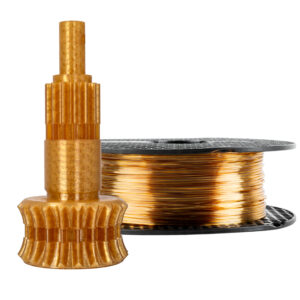
Basic info Composite materials filled with metal or wood powder are usually PLA or PETG filaments. The additives may give them special properties and attractive looks. They are…
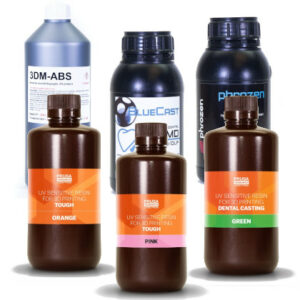
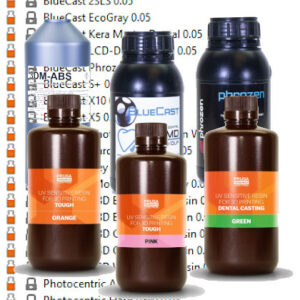
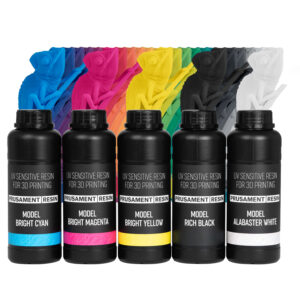
Liquid resins are photosensitive materials used for printing on DLP, SLA and MSLA 3D printers. Resins are also known as photopolymers and they are cured (solidified) by UV light…
We have tested hundreds of resins before we released the SL1, and still are trying out different types, colors and brands. The table below is extracted from PrusaSlicer, per January…
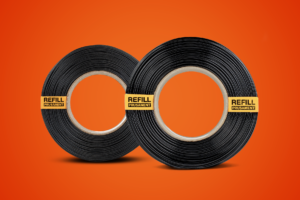
Prusament Refill is designed to fill up empty filament spools. Once you run out of filament, detach the black plastic sides of the spool and attach them to the Prusament Refill.…
You’ve probably guessed it already but the PEI 1010 isn’t exactly a “plug and print” material like our basic Prusaments (PLA, PETG…). Although we do our best to make our filaments…
If you're using the HueForge program, you might find these values useful. The HueForge transparency (TD) and HexCode values are measured for all of our Prusament materials and…
When printing various resins, you may notice a more or less significant yellowing effect after curing your models. This affects most MSLA materials, including all of our Prusament…
PPS or Polyphenylene sulfide is a semi-crystalline technical thermoplastic material suitable for 3D printing characterized by high resistance to heat and chemicals. The main characteristic…
Introduction In this article, you will learn everything you need to know when mixing resin colors using the Prusament Model Resin Color Kit - either with the help of the Sample…
Basic info Ultem, also known as PEI (Polyetherimide), is a high-performance thermoplastic material ideal for 3D printing. Its extreme resistance to heat and chemicals makes it…
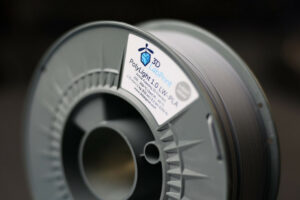
Basic info LW PLA is a filament that can expand during printing. It is useful for parts that need to be light. Recommended nozzle temperature: 210 - 250 ºC. Recommended bed…
PEEK-CF is an advanced thermoplastic filament with excellent mechanical properties and high-temperature resistance. This material is based on polyetheretherketone (PEEK) with added…
PSU, or Polysulfone, is a technical thermoplastic material with an excellent combination of properties that make it suitable for various applications including 3D printing. Its…
PEKK-CF is an advanced thermoplastic filament combining excellent mechanical properties, high-temperature resistance, and chemical stability. This material is based on polyetherketoneketone…
PPSU (polyphenylsulfone) is a technical thermoplastic material with excellent resistance to heat and chemicals and superior hydrolytic stability. The main characteristic of this…
Prusament TPU 95A is a flexible material with high mechanical resistance and print reliability. Although it’s one of the easiest flexible materials to print, it still requires…
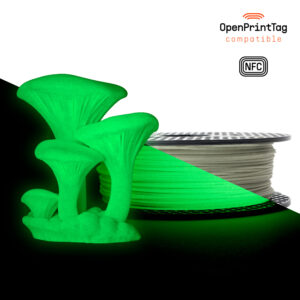
Prusament PETG Ultraglow green is the brightest glow-in-the-dark filament on the market. It is filled with the highest possible amount of strontium aluminate, which is the hardest…
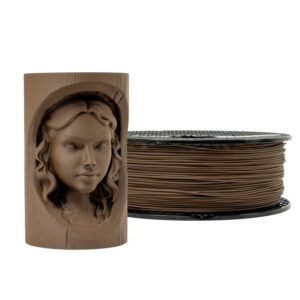
Prusament Woodfill is our own in-house-made filament with ±0.04 mm manufacturing tolerance. The material is filled with wood for great looks, while it maintains very easy printability. Recommended…
PETG V0 is the one-in-the-world UL-certified self-extinguishing PETG filament. It is especially suitable for housings and insulating parts in electronics, due to its self-extinguishing…
Prusament PETG Magnetite 40% is a specialized technical material with unique paramagnetic properties and high density. It is filled with fine magnetite powder, making it responsive…
Prusament PETG Tungsten 75% is a high-density material containing 75% tungsten powder. This non-reactive, hypoallergenic, and non-toxic filament is designed primarily for printing…